
Welcome to the Youth Hub!
Are you a youth who has applied for special immigrant juvenile status and are still waiting for your turn to apply for your green card? Below you will find information about the SIJS backlog, deferred action, and higher education resources for undocumented students.
There are many ways for impacted youth to get involved in our work! From meeting with members of Congress to ask them to end the backlog, to attending one of our community gatherings or working group meetings or by staying engaged with our social media platforms, the Coalition needs your voice!
To learn more about ways to get involved with the End SIJS Backlog Coalition and connect with other youth, fill out our interest form!
If you have any questions or would like to see additional resources on this page, you can contact the coalition’s Youth Organizer at maracuya@nipnlg.org.
Youth Resources
Latest News
Deferred Action Termination
On June 6, 2025, the Trump Administration put an end to the SIJS Deferred Action Policy. The End SIJS Backlog Coalition stands in solidarity with SIJS youth everywhere. On July 17, 2025, the National Immigration Project and partners filed a lawsuit challenging USCIS’s termination of the SIJS Deferred Action Policy. See our press release for more information.
On November 19, 2025, the U.S. District Court for the Eastern District of New York stayed U.S. Citizenship and Immigration Services’ termination of the Deferred Action Policy while the case is ongoing. The 2022 SIJS Deferred Action Policy is therefore back in effect for certain youth (see below), and the government must once again make initial and renewal deferred action decisions for certain SIJS youth. Moreover, SIJS beneficiaries with deferred action are again able to apply for work authorization.
This decision is something to celebrate but it is also not perfect. In the decision, the judge said that parts of the original SIJS Deferred Action Policy that give a lot of weight to a SIJS approval as a reason to grant deferred action are not included in what the court reinstated–except for a small portion of youth whose SIJS petition was approved on or after April 7, 2025 and before June 6, 2025. The plaintiffs feel this is not correct and on February 3, 2026, they appealed this part of the decision to a higher court. That appeal is currently pending.
On April 16, 2026 USCIS issued a new policy re-terminating the SIJS Deferred Action Policy. This policy went into effect on May 10, 2026 and applies to SIJS petitions and deferred action renewal requests submitted on or after May 10, 2026. See below for more information on how this may impact you.
We will continue to push forward alongside you for your right to remain safely in the United States. Read below to find ways to get involved with the coalition and to make your voice heard.
Latest Priority Date on the Visa Bulletin
You can file your green card application if your priority date is current on the chart(s) specified below
This Month: October 2026 Dates for Filing is January 1, 2025.
Last Month: September 2026 Final Action Date is December 15, 2022.
Remember: Your priority date is the date USCIS received your SIJS petition, and it marks your place in line for a green card. You can find your priority date on your I-360 receipt or approval notice.
If you are still unsure of your priority date, we recommend reviewing our visa bulletin resources below or contacting your attorney.
Deferred Action Resources
THIS SECTION IS UP TO DATE AS OF MAY 14, 2026
Read through below to learn more about how the end of the Deferred Action Policy may impact you.
-
Your deferred action and your work authorization are still valid until they expire, unless you receive a notice of termination.
-
If you filed a deferred action renewal before May 10, 2026, USCIS will apply the 2022 SIJS Deferred Action Policy when deciding your application.
If you file a deferred action renewal request on or after May 10, 2026, USCIS will not consider your request under the 2022 Policy and instead will apply their new general deferred action guidance to the request. That guidance says that USCIS will only grant deferred action in what it considers “extraordinary and compelling” situations, and that USCIS does not consider approved SIJS as a positive factor. The new guidance also says that if someone who is in immigration court removal proceedings files a deferred action request with USCIS on Form G-325A, USCIS will deny it.
-
If you have deferred action, you are eligible to apply for a work permit.
-
If USCIS received your SIJS petition before May 10, 2026, USCIS should make a decision on whether or not to grant you deferred action based on the 2022 SIJS Deferred Action Policy. USCIS has to do this automatically without you filing any separate request, but USCIS does not have to make the deferred action decision at the same time as the SIJS approval. This also does not mean that USCIS has to grant deferred action–they just have to decide whether or not to give it you.
If USCIS received your SIJS petition on or after May 10, 2026, the new April 2026 USCIS policy re-terminating the SIJS Deferred Action Policy will apply to you. This means that USCIS will not automatically consider you for deferred action based on your SIJS approval. Just like anyone else, someone with approved SIJS can still file a deferred action request with USCIS, but USCIS will apply their new general deferred action guidance to that request. That guidance says that USCIS will only grant deferred action in what it considers “extraordinary and compelling” situations. The new guidance also says that if someone who is in immigration court removal proceedings files a deferred action request with USCIS on Form G-325A, USCIS will deny it.
-
If you have not yet filed an SIJS petition, the April 2026 policy re-terminating SIJS deferred action applies to you. This means that USCIS will not consider you for SIJS Deferred Action. However, just like anyone else, you could file a deferred action request with USCIS, but USCIS will apply their new general deferred action guidance to that request. That guidance says that USCIS will only grant deferred action in what it considers “extraordinary and compelling” situations. The new guidance also says that if someone who is in immigration court removal proceedings files a deferred action request with USCIS on Form G-325A, USCIS will deny it.
Understanding SIJS Resources
The resources below explain what Special Immigrant Juvenile Status is and what the SIJS Backlog is.
How to check your case online for special immigrant juvenile status (SIJS) on the USCIS website
Below is a guide and a video on how to check the status of your case online.
1st step: Visit this website https://www.uscis.gov
2nd step: Click where it says “tools” at the top right-hand corner.
3rd step: Scroll down to where it says “Case status online,” then click on it.
4th step: Here you will see a blank asking to enter your receipt number. Your receipt number should start with the letters MSC on your SIJS petition receipt or approval notice (Form I-797).
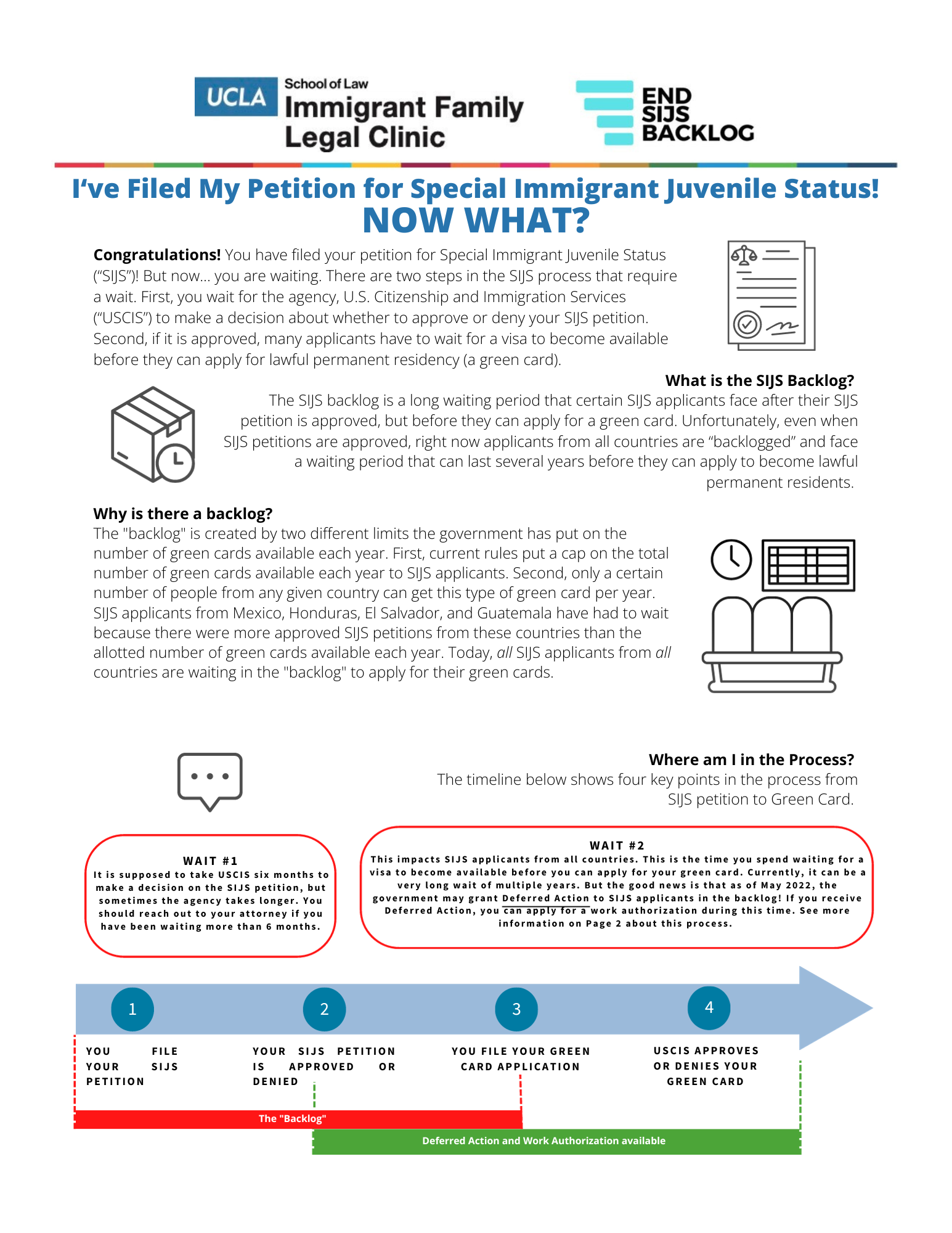
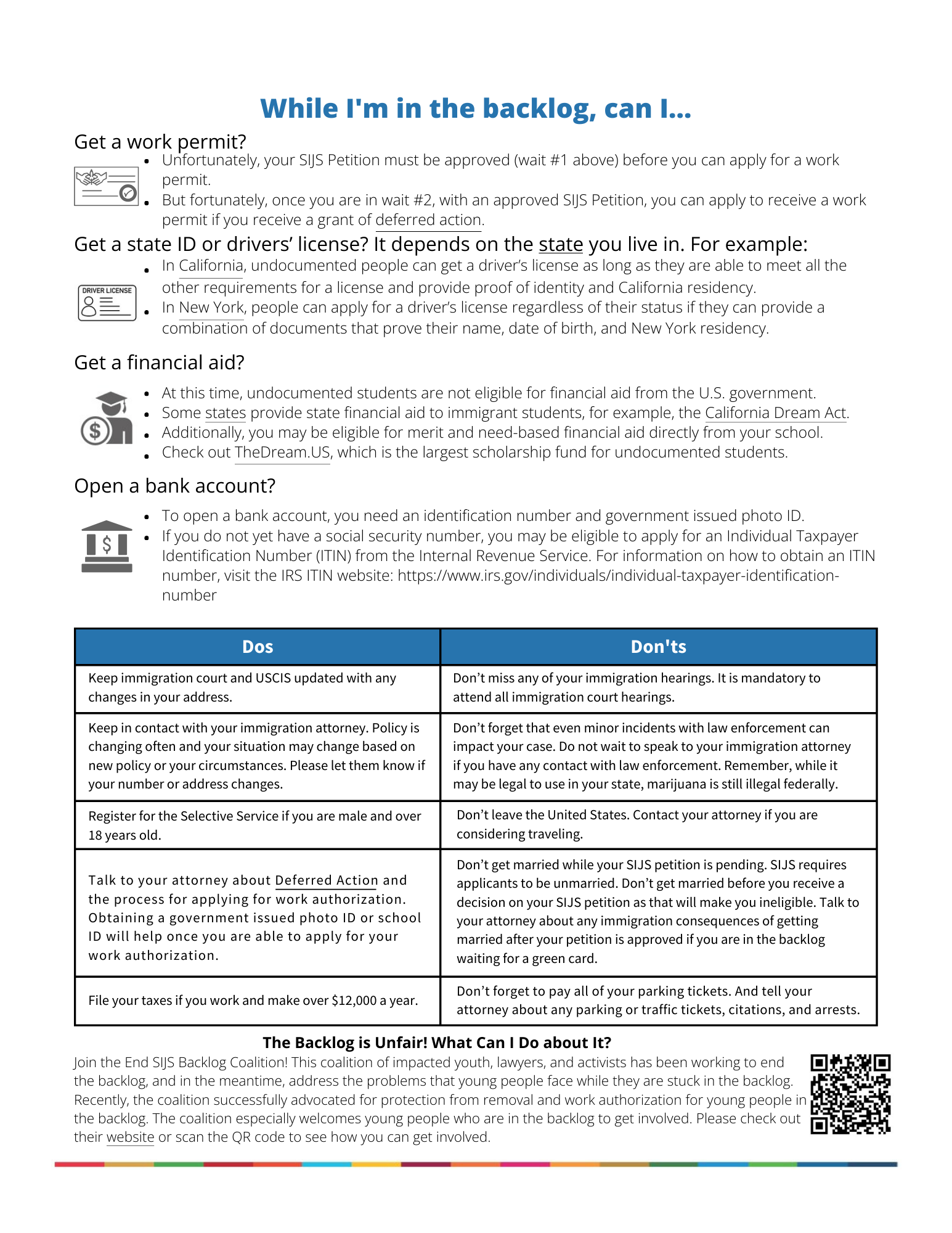
Youth with SIJS spend a lot of time visiting the Department of State’s Visa Bulletin webpage to find out if they can apply for a Green Card yet. They are often confused about what the different parts of the bulletin mean and how exactly to find out where they are in line to get their Green Cards. Due to the confusing nature of the visa bulletin and direct feedback from SIJS youth, the End SIJS Backlog Coalition has created the resources below for SIJS youth.
Visa Bulletin Resources
Why is there a “U” on the Visa Bulletin right now?
Since April 2025, the Visa Bulletin's EB-4 Final Action Dates Chart shows a "U." This change has raised many questions from youth with Special Immigrant Juvenile Status (SIJS) about its meaning. This resource explains what the "U" means for SIJS youth.
April and May 2026 Visa Bulletins:
What SIJS Youth Need to Know
The Visa Bulletin has moved forward significantly in the last few months, raising a lot of questions from SIJS youth. The resource below explains how to understand the Visa Bulletin's recent changes and their impact on your case.
3-Part Video Resource about the Visa Bulletin
The following videos get into everything you need to know in order to understand the visa bulletin. Each video builds off of the information presented in the previous one. We highly recommend you watch all of the videos in order.
Video 1: SIJS Background and the Backlog
This first video covers what you need to know about Special Immigrant Juvenile Status, what the SIJS backlog is, and why it exists.
Video 2: Explaining Visas and the Defining the Visa Bulletin
This second video will focus on what visas and the visa bulletin are, and an explanation of all the different parts of the visa bulletin.
Video 3: A Step-by-Step on How to Actually Read the Visa Bulletin
This final video uses information from the first two videos to give you a step by step breakdown of how to correctly read the visa bulletin.
Written Explainer about the Visa Bulletin
This written explainer accompanies our video resources and gives you a step by step breakdown of how to check the Visa Bulletin correctly! Make sure to watch the videos too!
Are you still confused about the Visa Bulletin? Our Youth Organizer, Maracuya, is here for you! Email, maracuya@nipnlg.org for some 1:1 help!
Higher Education Resources
There are several different paths impacted youth can take after high school. We recommend checking out these educational resources to help you assess your options for continuing your education after high school.
Informed Immigrant
A digital hub with an accessible resources library and information for the undocumented community in the United States.
Immigrants Rising
An organization that offers support and resources for undocumented students in California and on a national scale.
Higher Ed Immigration Portal
This portal is an online hub of resources that has tuition and financial aid information for all 50 states.
Scholarship Resources
SIJS youth do not qualify for federal financial aid, thus making it challenging to afford higher education. Scholarships provide an alternative source of funding and help break down financial barriers. Below you will find links for national scholarships and scholarship databases.
USAHello has a scholarship page that lists national and state scholarships, scholarships that are specific by fields of learning and ones that are specific by nationalities and groups.
Immigrants Rising has a list of scholarships and fellowships that do not require proof of U.S. citizenship. Make sure to search for scholarships that allow any immigration status as some scholarships listed may require DACA or TPS status.
Golden Door Scholars is a financial aid program open to undocumented students in the United States. High school seniors, recent high school graduates, and current college students are eligible for this program.
To learn more about ways to get involved with the End SIJS Backlog Coalition and connect with other youth, fill out our interest form!
If you have any questions or would like to see additional resources on this page, you can contact the coalition’s Youth Organizer at maracuya@nipnlg.org.